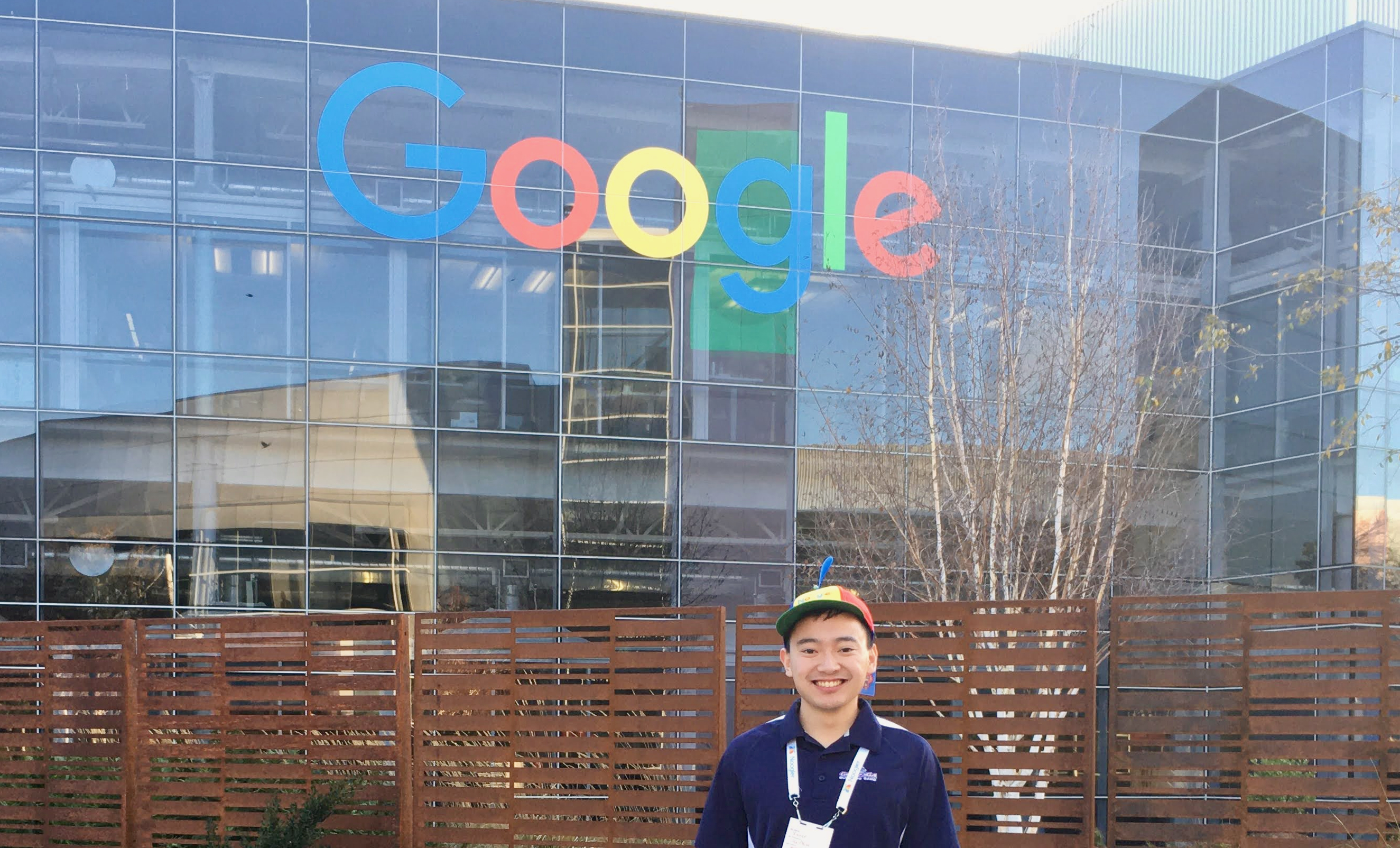
AI Tools & Career Growth: Speaking at Gonzaga University
By Xavier Collantes
8/8/2026
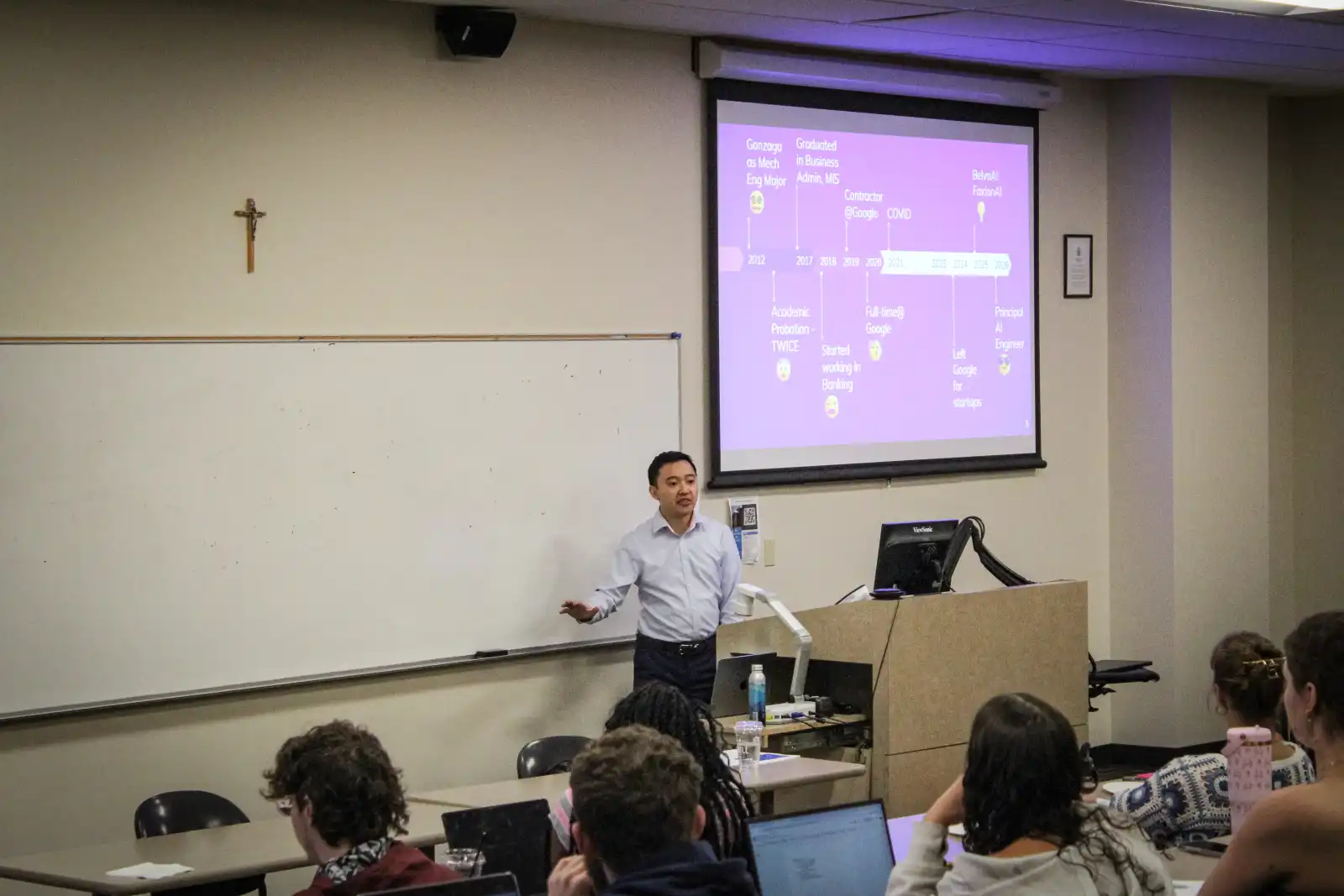
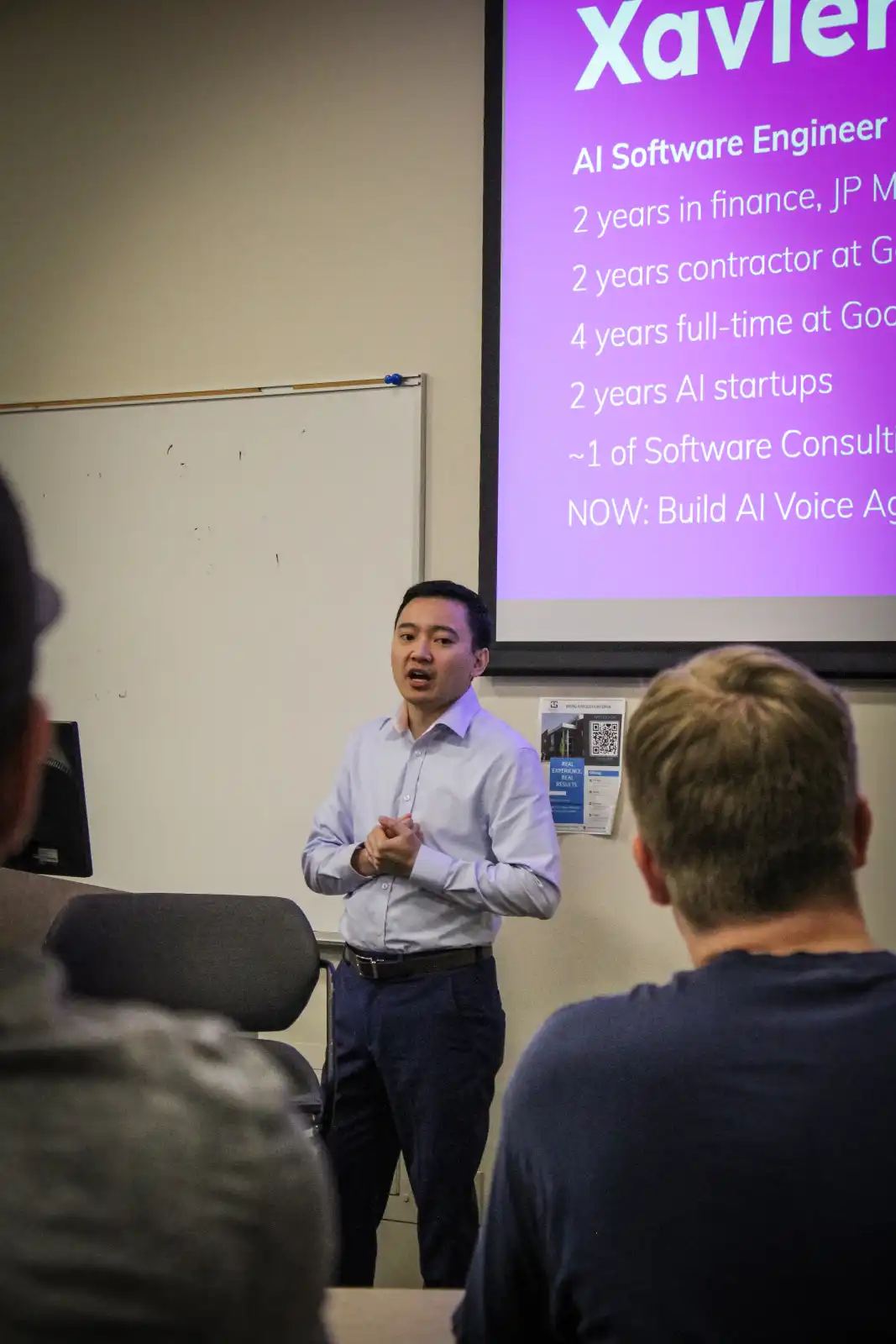
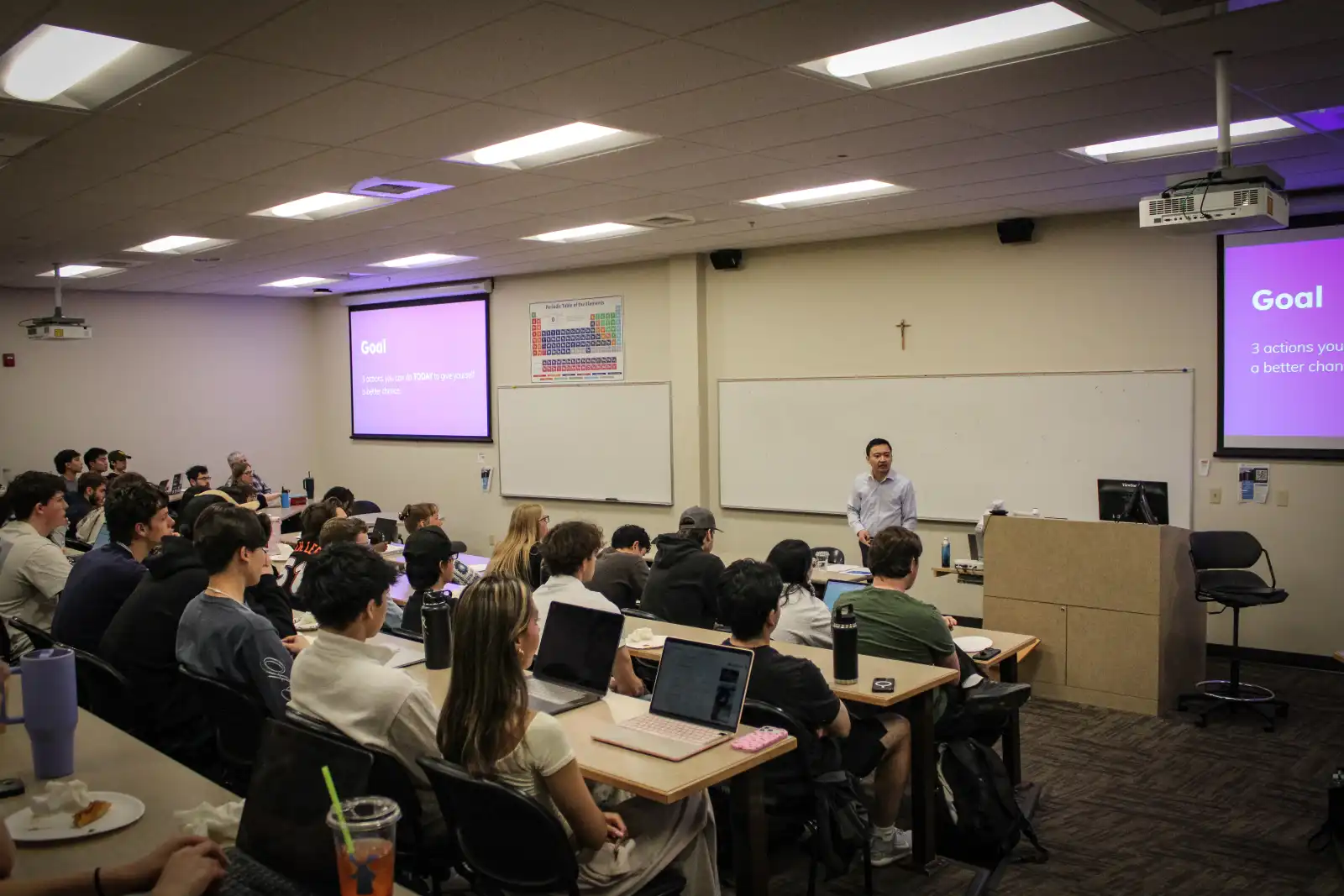
I spoke with a handful of classes, gave a presentation to about 80 students, met
with Computer Science and Information Systems faculty, and sat down with
students for career conversations. I also had the chance to reconnect with two
of my beloved undergrad professors, Dr. Ta Tao Chuang and Dr. Tim Olsen.
Given the opportunity, I wanted to convey a clear message as a foundation for my
presence on campus: The job market is tough right now, but here are the three
actions you can take today to improve your chances.
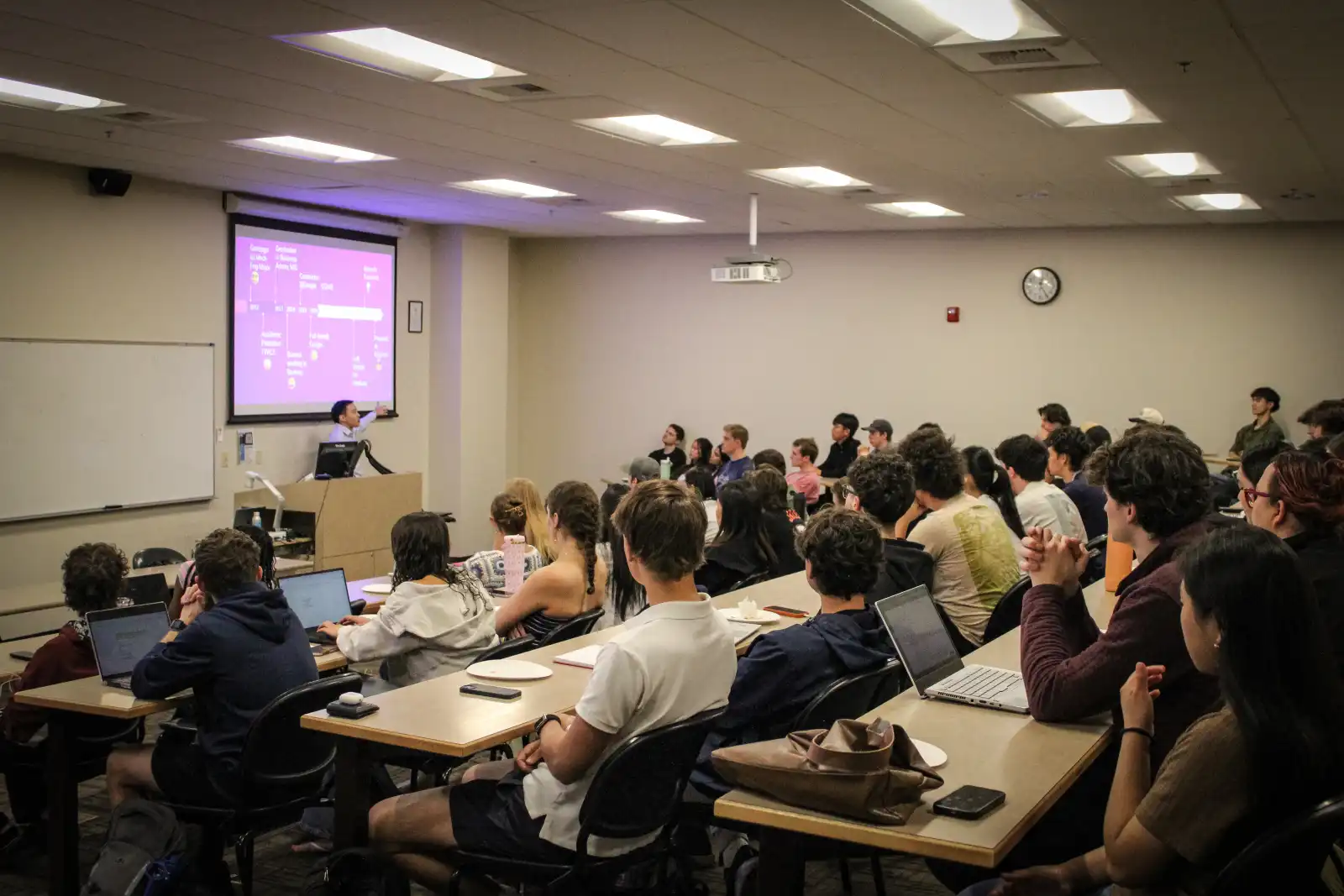
For preparation for this visit, I thought about the many talks I attended as a
student that left me asking questions like "Networking is important, great...
How do I get started?" or "Cool to hear about your accomplishments but how do I
deal with career difficulties?"
Finally I had the chance to be the speaker that I wished I had as a student.
The Non-Stop Schedule

- 8:00 AM - Meet with department head
- 9:00 AM - One-on-one with professor
- 9:40 AM - Speak to a class about the latest AI tools
- 10:10 AM - Speak to another class about career paths
- 10:30 AM - Coffee break, thank you Thomas Hammer Coffee Roasters
- 11:00 AM - Speak to a third class
- 11:30 AM - One-on-one career advice with a student
- 12:00 PM - Presentation to about 80 people on three actions to take in growing your career
- 1:30 PM - Lunch with a professor friend
- 2:30 PM - One-on-one with another professor
- 3:00 PM - One-on-one with another professor
- 3:30 PM - One-on-one advising a student on AI Engineering architecture

You Miss One Hundred Percent Of The Shots You Do Not Take
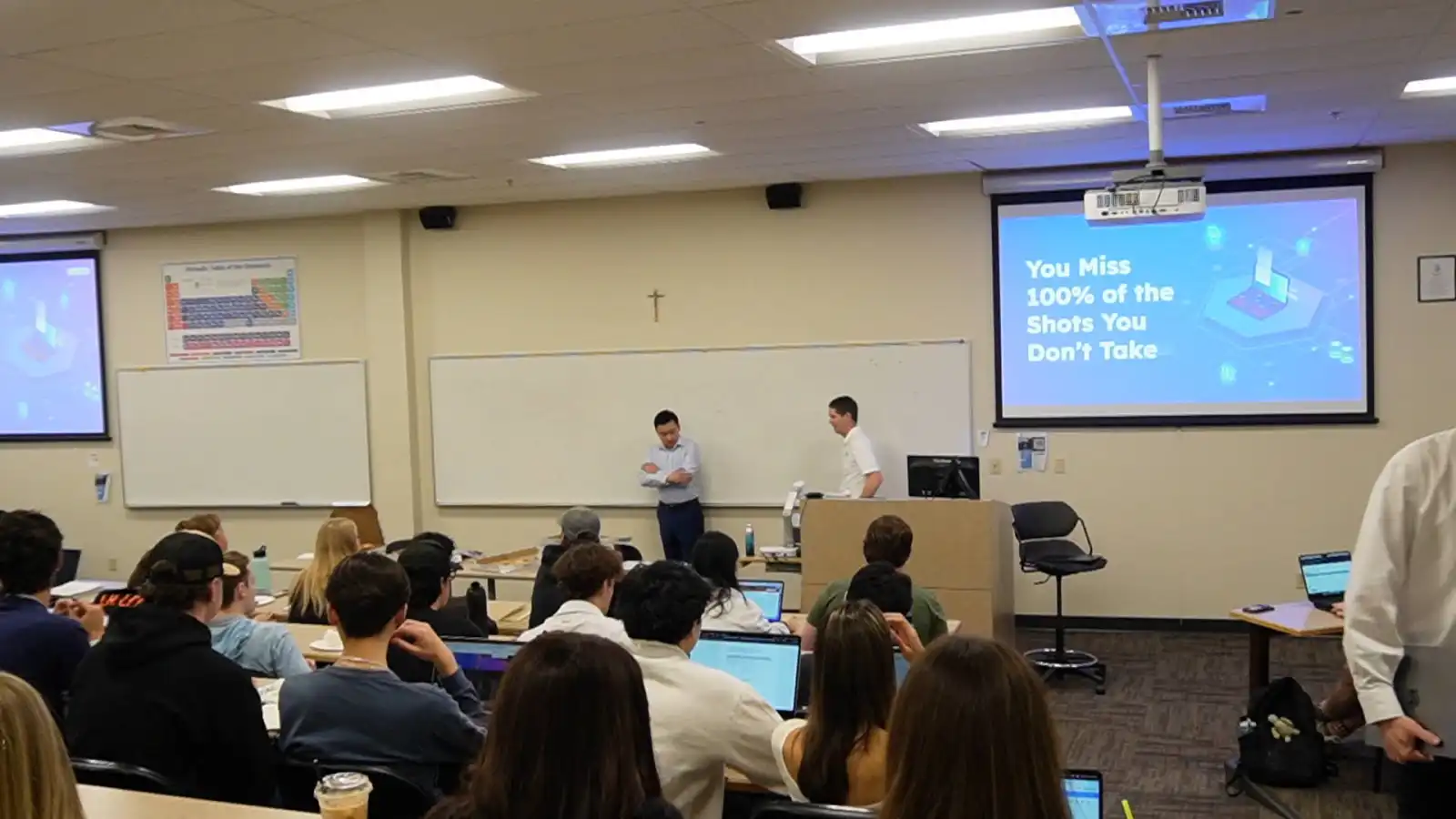
That is what I named the main talk because I believe the undervalued skill is
taking action with persistence. For every success I had could be traced to a
bold decision I made. From offering my web design skills in exchange for housing
in college to deciding to quit banking and pursue a career in technology.
My whole career has been riddled with unexpected challenges that forced me to
adapt and grow. As Bruce Lee once said, "Do not pray for an easy life, pray for
the strength to endure a difficult one."
Action #1: Build Your Own Board Of Directors
Companies keep a board of directors because they want advice from people who
know more than they do. There is no reason you cannot have one.
Mine includes a professor who helped me land an internship, a former manager who
writes me letters of recommendation, a peer who forwards me every new AI tool
before I hear about it elsewhere, and a recruiter at Amazon to get the
perspective on what they are looking for.
The point is the diversity, not the headcount. A recruiter and a hiring manager
read the same resume and see different things. Diversify across years of
experience, perspective, and expertise. You never have to ask anyone to formally
be on it. These are the mentors and advisors you gather as you go.

Do the work up front. Everyone is busy, and a request is you asking someone
to do more work. Compare two messages. The first asks a professor for a letter
of recommendation, which costs two days of back-and-forth establishing what the
job is and which skills to highlight. The second arrives with the role, the
skills worth mentioning, and a draft already written. The second gets answered
far faster. Multiply that across ten requests.
Template the request and let AI do the typing. I keep a corpus of my own
material - past resumes, cover letters, letters of recommendation - in a folder
that Claude Code can read. When I need a new one it drafts from my own writing.
I read every word before it goes anywhere. The professor on the other end can
then copy and paste it straight into whatever form or email they need.
Match the job description. People still send one fixed resume everywhere.
Mirror the posting's wording closely.
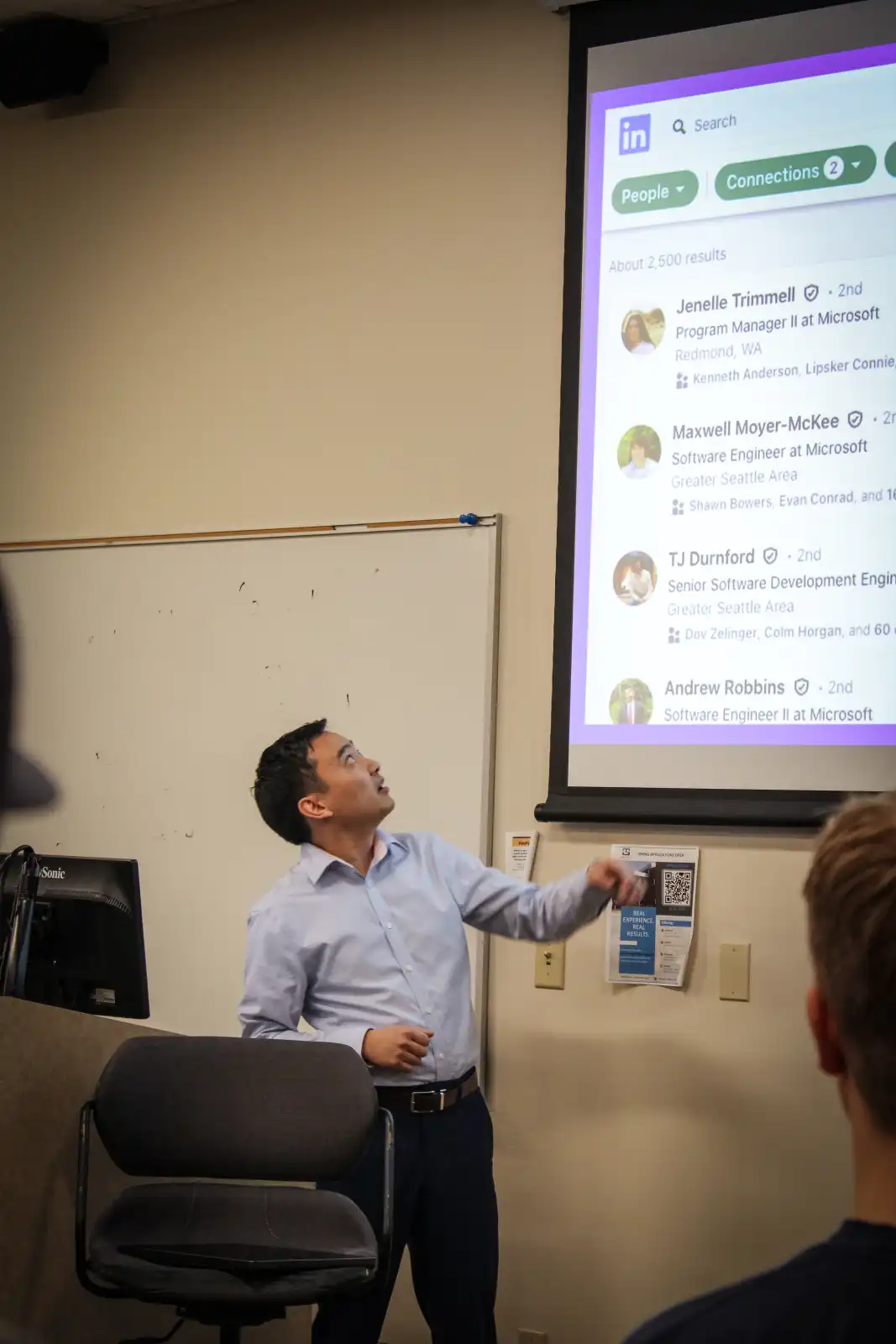
Use LinkedIn with a target. Suppose I want to be a program manager at
Microsoft. I look up the people who hold that job and check who they are
connected to. If a professor of mine already knows one of them, I can ask for an
introduction. That is directed networking. It beats talking to a large number of
people with no particular objective.
Action #2: Get Experience And Document It

Roughly nine out of ten students I speak with are doing genuinely impressive
work. Put them in an interview room or at a networking event and they cannot
articulate any of it.
Showing beats telling, every time.
Start doing the job you want now, not later. The slide automation at J.P.
Morgan was not my job. It became my career.
Internships are the obvious route and they are harder to get right now. They are
not the only route.
- Technical students can open pull requests against open source projects, which come with a permanent public record of the work.
- Clubs and your own community are full of real problems worth solving.
- Marketing students can run a social media campaign for a club or a Spokane coffee shop for free.
- Finance students can run logistics and accounting for a large event.
Here is my own version.
One summer I wanted to stay on campus and my parents
were not going to pay for it. The dorms were sitting empty, and the housing
website was notoriously bad for finding anything, any student could tell you that.
So I went to the housing department and offered to redo their web content in
exchange for a place to stay. They agreed.
Was it an official internship? No. Was it real experience with something to show
for it? Yes. And it is a story I can tell in an interview.
Build a portfolio. Get the artifacts in hand. It does not need to be custom
built, mine is, because I am a Software Engineer so my artifact should reflect
that, but Wix is fine. Start writing blog posts. The goal is a repository of
work you can point to and talk about for as long as anyone keeps asking.
Action #3: Play With The AI Tools
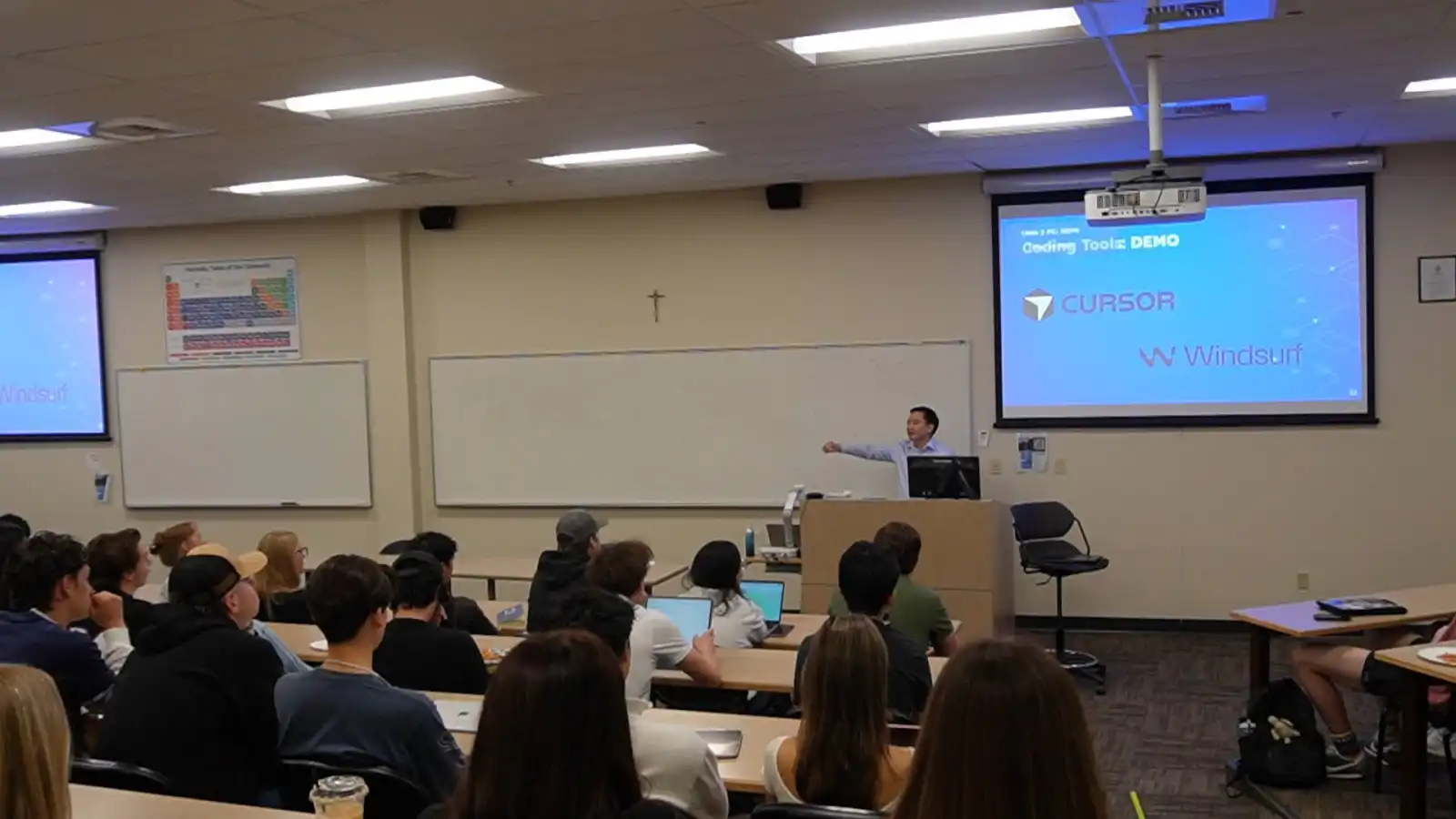
There is high demand for these skills and it is genuinely hard to hire for.
I have colleagues at Google and Meta with degrees from MIT and Stanford who ask
me what the new coding and AI tools are, and then tell me they do not have time
to learn them. They are busy doing their day jobs.
You are in a learning phase. That is the advantage, and it will not last. Point
your learning at whatever shows up in the job descriptions you are targeting.
This applies to every concentration, not only the technical ones.
An agent that writes my LinkedIn posts. I hand it a link. It verifies the
URL, drafts the article, passes the draft to a second agent whose only job is
making it not sound like AI wrote it, then loops through a revision agent until
I approve. I stay in the loop and I post it. That used to be about five hours a
week. It is now about fifteen minutes.
A website built from a prompt, live in the room. I gave it a prompt
describing the MIS department, its school colors, and what the program is, then
let it build a site from scratch while we talked. It came back with a working
site, hover states and all. The barrier to making an idea real is gone. You no
longer need to find someone to wireframe an MVP for you.
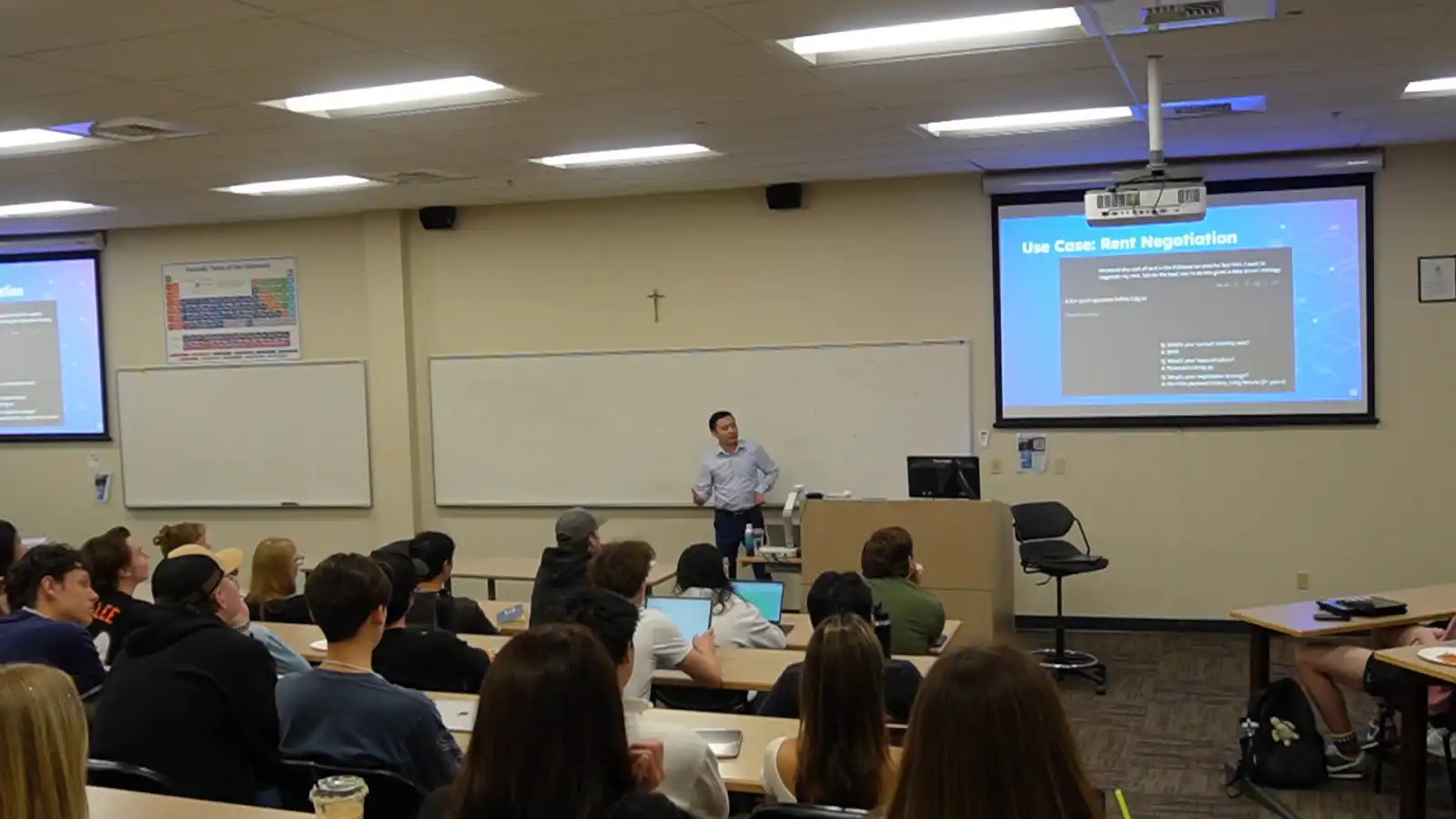
Negotiating my rent. A few weeks before the talk I asked for research on
one-bedroom rents in my area and a data-driven argument I could send over email.
It asked me what I currently pay, when the renewal lands, and how long I have
lived there. It produced an email citing comparable units nearby and local rent
trends, with links. I checked every link against what the email claimed. My
landlord agreed. That was about $130 a month, roughly $1,500, for ten minutes of
work.
The tools worth knowing right now: ChatGPT and Manus for general work, and
LangChain, Cursor, and Claude Code if you want real control over code.
Learn the fundamentals of your field first, then use creativity to find where
this technology actually creates value. You do not have to sell anyone on AI.
The news does that. You can be the person who knows how to apply it.
What Students Asked
The questions were better than the talk.
How should a cold outreach message be formatted? Short and direct. Who you
are, what you have done that matches what they need, and what you want. People
are busy and the fluff costs you.
How do you give an AI model the right context? Prompt engineering has a next
step called context engineering. Talk to a model the way you would talk to a new
intern who is eager but does not know the job yet. Give examples of good output,
examples of bad output, and instructions for the edge cases. For anything
running in production, build real evaluation systems, in the same spirit as
test-driven development.
What about sensitive data? Large companies spin up enterprise instances so
prompts do not train the public model. Beyond that, scan and redact outputs. I
have had a model hand me somebody else's API key, which means someone put it in
the training set. In production you do not dump everything into one model. You
build a workflow where each model does one narrow job.
When does the bubble burst? Deloitte puts about 95 percent of AI projects as
doomed. That tracks. Most are experiments that never connected to the business.
At one startup I asked a product manager how many users had asked for what we
were building. Nobody had asked. That is a red flag. The guardrail is simple: on
my team we name the dollar value before we start building. The projects that
survive are the ones tied to a number.
What are you afraid of? I turned this one back on the room. They said
environmental cost, and jobs - specifically that AI gets good enough at
entry-level work to close off the entry-level roles they are about to apply for.
That is a real concern and I did not pretend to have solved it. Nobody has. What
I said is this: do not try to plan around where this lands in ten years, because
I do not know where I will be in ten years either. Focus on what AI cannot do
right now and differentiate there. Software Engineering is not going away, you
still have to read what a model produces and catch what is wrong in it. The
human judgment in that review is the part that still belongs to you.
How is job hunting different once you have experience? Experience gives you
a repository you can draw on indefinitely, which is the entire point of
documenting your work. When I was new I did not have official experience beyond
one internship and the housing project, so I leaned on side projects and
curiosity. I still build things for fun. In my last interview they wanted
someone to automate newsletter production, and I mentioned I had already built
exactly that for a friend who is a financial advisor, for free, because I
thought it was interesting. They decided to pay me to keep doing the thing I was
already doing.
Listen to your gut and try things. My time in finance did not work out, and that
is fine. It told me exactly what I wanted to do instead.
Working With Students
I offer one-on-one help to students on career ideation, resume building, and
interview preparation.
Internships are harder to get than they used to be. Experience is easier to
build than it used to be. Look at the clubs, the communities, and the people
around you, and ask where you could spin up something useful in an afternoon.
Work that used to cost ten thousand dollars is now within reach of a student
with a free afternoon and some curiosity.
Thank you to the Information Systems Department for hosting me for a full-day
visit at Gonzaga University, School of Business Administration.
See my other work volunteering for students:
Related Articles
Related by topics:
ai
llm
gonzaga
speaker